
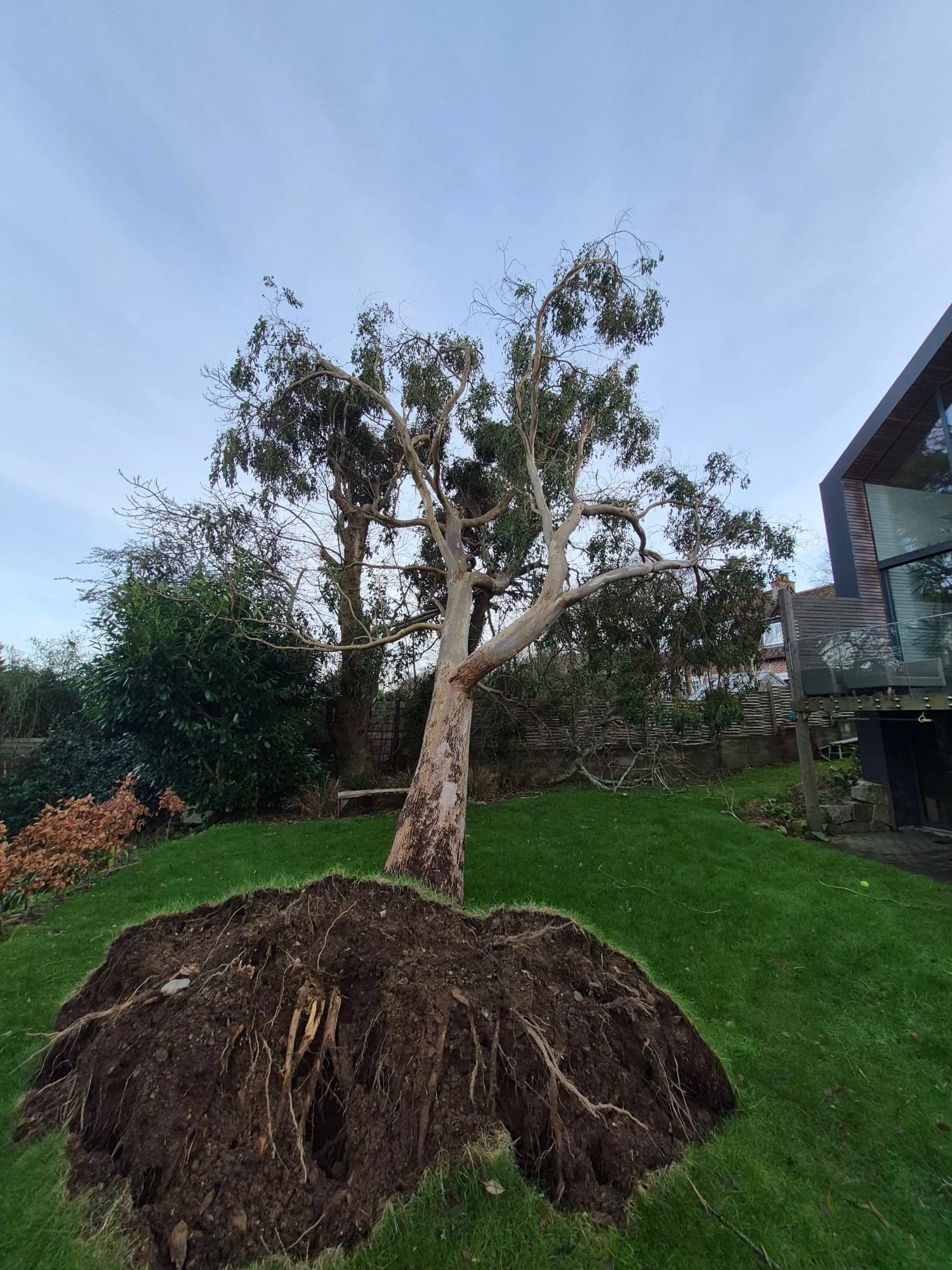
First, what not to touch
A fallen tree is not a standing tree lying down. Its weight is held up by branches under compression, the stem may be under tension like a bent bow, and the root plate is often only held down by the weight of the trunk. Cut the wrong thing and the stem rolls, a branch springs back, or the root plate stands up and takes the trunk with it. People are killed every year clearing storm damage with a chainsaw they use twice a decade.
- Anything touching a power line. Ring 105 for the electricity network and stay well clear.
- A tree or limb hung up in another tree. It will come down; the only question is when and on whom.
- A stem under tension, a leaning tree with lifted soil, or a limb cracked but still attached. These store energy and they release it without warning.
- Anything on a roof, a conservatory or a car. The tree is often holding the structure together.
- Anything you cannot reach with both feet on the ground. Ladders and chainsaws do not mix.
What you can do straight away
Photograph everything before anything is moved, from several angles, including the base and root plate. Your insurer will want it, and so will your neighbour if the tree crossed a boundary. Keep people and pets away from the tree and from anything it is leaning on. If a lane or drive is blocked and you can clear small branches by hand without going under anything, do, but leave the trunk and the big limbs. Then phone. Tell us what has fallen, what it is on and whether anyone can get in or out, and we will give you an honest time.
Can a damaged tree be saved?
More often than people expect. Whether it is worth it depends on the species, the age of the tree, how much of the crown is lost and what the damage has done to the structure.
A tree that has lost a limb, even a big one, is usually fine once the wound is cleaned up with a proper cut to the branch collar. The tree will seal it over the years, and a reduction of the rest of the crown can bring the shape back into balance so it does not develop a lean towards the light.
A split fork, where two stems have torn apart at the join, is more serious. If the split is small and the tree is valuable, it can be braced with a rod or a cable system and the crown reduced to take the load off. If the split runs down into the stem, one side usually has to come off, and the tree becomes a smaller one.
A snapped top, common on conifers and on tall thin trees in plantations, can be tidied with a cut below the break. The tree will not regrow a leader on most conifers, but it will live, and it can be reduced to a safe shape.
A tree that has blown over with its root plate lifted is the surprising one. Small trees can simply be stood back up, staked and watered. Larger trees usually cannot, because too many roots have broken, but some can: the two sessile oaks on our home page had grown out of a hedge bank and were blown flat. We pollarded them where they lay to take the weight off, winched them upright and let the root plates settle. They came into leaf this spring and will be re-pollarded every ten years or so to keep them stable. It is not something to attempt on a tree over a building, but on a bank or in a field it is a genuine alternative to losing a tree that took a century to grow.
When it has to come out
A tree that has failed at the base, split through the main stem, or lost more than about half its crown is usually beyond saving, and a tree that has fallen onto a building has to be got off it in a way that does not do more damage. This is crane work where a crane can be got in: the stem is supported by the crane before it is cut, and lifted clear in one piece rather than cut into small sections above the roof. Where a crane cannot reach, the sections come off carefully with rigging and the root plate is lifted out afterwards with the digger.
The timber goes for firewood, and if we take it from your property you qualify for the discount on cut and split logs delivered back. The root plate hole is backfilled and levelled, and the lawn can be repaired in the spring.
Insurance
Most household policies cover removing a tree that has fallen onto an insured building or fence, and some cover the tree that fell on nothing at all. Every insurer wants the photographs, a written quote and an invoice, and some want to be told before the work starts. We provide all of it and can talk to the loss adjuster. If the tree was your neighbour's, or fell on your neighbour, the general rule is that the owner of the land it grew on is responsible, but the details depend on whether the tree was known to be unsafe, and your insurer is the right first call rather than an argument over the fence.
Before the next storm
Almost every failure we cleared last winter had a visible cause beforehand: dead wood, a bracket fungus at the base, a fork holding water, a lean that had grown, roots cut for a new drive. A walk round in late summer, or a free tree health check, finds most of them while a light prune or a reduction is all that is needed.
Written by TR Trees, tree surgeons near Truro. General guidance for homeowners and landowners in Cornwall; every tree is different, and a look in person is always better than a rule of thumb.