
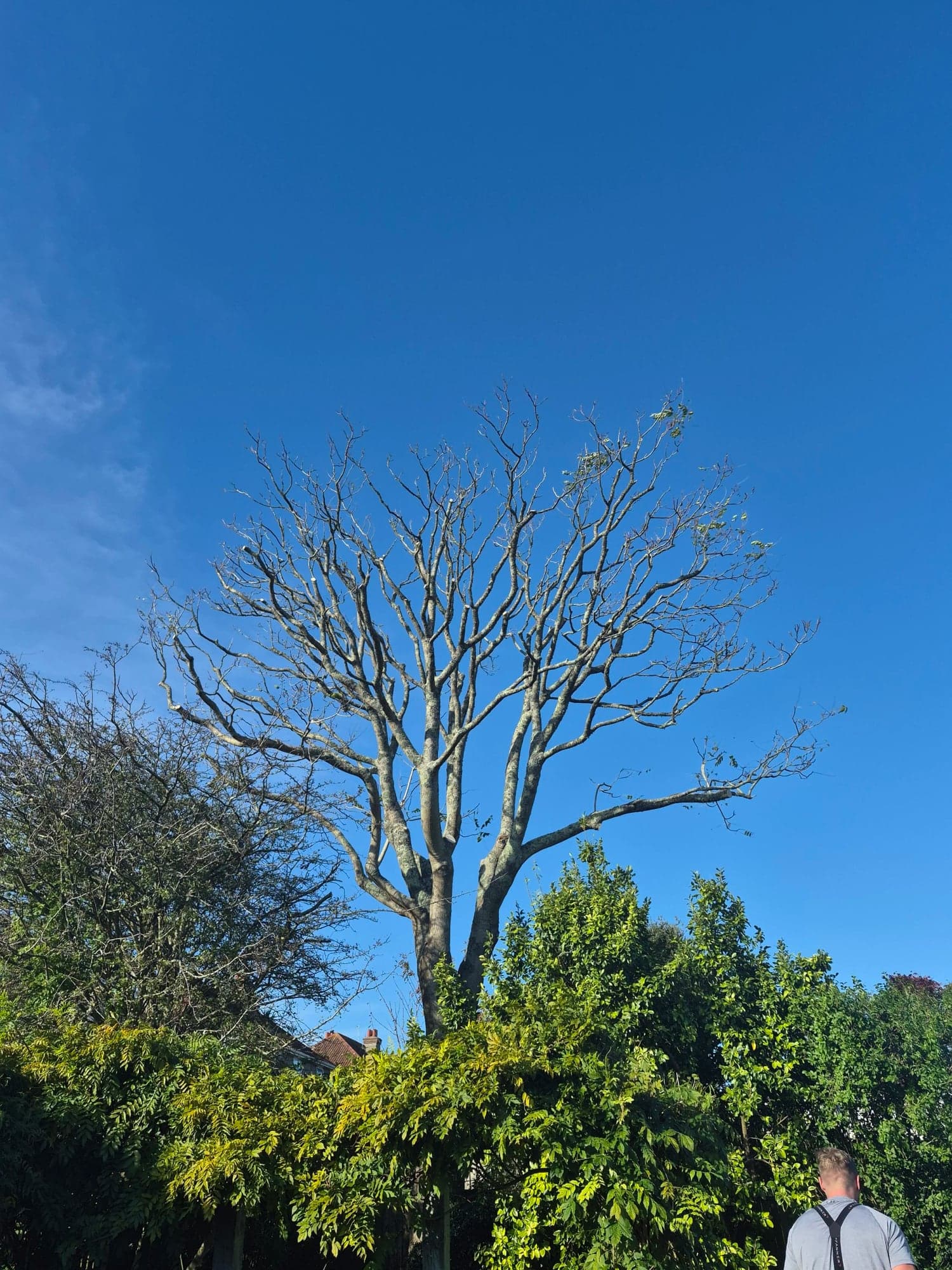
How decay gets into a tree
Wood does not rot on its own. It is broken down by fungi, and a fungus needs a way in. On a living tree that means a wound: a branch torn off in a storm, a stub left by a bad pruning cut, bark stripped by a strimmer or a car, a root cut by a trench for a drain, or the natural fork where two stems meet and hold water. Spores land on the exposed wood, and if the tree cannot seal the wound quickly enough the fungus is in.
Trees do not heal wounds the way we do. They wall them off. A healthy, vigorous tree lays down barriers around a wound and grows new wood over it, and the decay stays contained in a pocket. A stressed tree, one struggling with drought, compaction, root damage or simply old age, cannot keep up, and the decay spreads along the grain into the stem or down into the roots. That is why the same fungus can be a curiosity on one tree and a death sentence on the one next to it.
Once inside, different fungi do different things. Some digest the lignin and leave the wood white, stringy and soft. Some digest the cellulose and leave it brown, brittle and cracked into cubes. Some hollow the centre and leave the outer shell sound, which is why a tree can stand for decades with an empty stem. Others work through the sapwood or the roots, where the loss of strength matters far more.
The fungi worth knowing in Cornwall
You do not need to identify every fungus on a tree, but a handful turn up again and again in Cornish gardens and woods and each tells a different story. The fruiting body you see is only the tip of it; the fungus itself is in the wood.
- Honey fungus (Armillaria). Clumps of honey coloured toadstools at the base in autumn, black bootlace strands under the bark and in the soil, and a white sheet of fungus with a strong mushroom smell under the bark at ground level. It attacks the roots and the base and it kills. It spreads through the soil to neighbouring woody plants, which is why replanting where it has killed a tree is unwise. The holm oak we removed in Penzance this summer was lost to it.
- Ganoderma brackets. Hard, hoof shaped, brown on top and white underneath, often with a dusting of brown spores on everything below. Found at the base of beech, oak, lime and horse chestnut. It causes a white rot in the roots and lower stem that can go a long way before the tree shows any sign in the crown, and it is one of the main reasons big old broadleaves fall over whole.
- Meripilus, the giant polypore. Large rosettes of overlapping fan shaped brackets at the base of beech in late summer, which blacken when bruised. It rots the roots, and a beech with Meripilus and a thinning crown is a tree that needs assessing quickly.
- Kretzschmaria, brittle cinder. A grey crust that turns black and lumpy at the base of beech, lime, maple and horse chestnut. It is easy to miss and it makes the wood brittle, so trees fail suddenly at the base without warning.
- Chicken of the woods and beefsteak fungus. Bright yellow shelves, or a red liver shaped bracket, on oak and sweet chestnut. Both cause a brown rot of the heartwood. On a large old oak they can be present for decades without the tree being dangerous, because the outer wood carries the load; they are a reason to keep an eye on the tree rather than to fell it.
- Dryad's saddle and other stem brackets higher up. These point at decay in a limb or a fork rather than at the base, and the question becomes whether that limb is over anything.
Signs that decay has reached a dangerous stage
The fungus itself is one signal. The others are in the shape and the behaviour of the tree.
- Fruiting bodies at the base or on the buttress roots, especially the ones listed above. A bracket high on a limb is a limb problem; a bracket at the base is a whole tree problem.
- A crown that is thinning from the top, with small leaves, early autumn colour or dead tips, on a tree that used to be full. The roots are no longer supplying it.
- Dead wood accumulating, particularly large dead limbs and dead sections on one side.
- Cavities and hollows, water pouring out of old wounds, and bark that sounds hollow or gives under a mallet.
- Cracks, either long vertical splits in the stem or a crack across the top of a buttress root. A crack that has recently opened or grown is urgent.
- A lean that has changed, lifted or cracked soil on the side away from the lean, or roots visibly heaving. This is a tree that has started to move and it needs looking at now, not in the spring.
- Woodpecker holes and sawdust from wood boring insects, which follow decay rather than cause it.
- Ivy thick enough to hide all of the above. Ivy is not the problem, but it stops anyone seeing the problem.
What we do when we find decay
The first job is to work out how much sound wood is left and where the load goes. A hollow stem with a thick, sound outer wall can be perfectly safe; engineers build tubes for a reason. We look at the extent of the decay with a mallet and a probe, and for valuable trees a consultant can measure it with a resistance drill or sonic tomography, which maps the sound and decayed wood without harming the tree.
Then the question is what the tree is near. A hollow oak in the middle of a field is a wonderful thing and can be left to live out its years. The same tree over a road, a drive or a house is a risk to be managed. Often the answer is to reduce the load rather than remove the tree: a crown reduction takes weight and sail out of the canopy so the weakened stem or roots have less to carry, and it can buy an old tree another decade or two. Dead wooding takes out the parts most likely to fall. Bracing can support a weak fork.
Sometimes the honest answer is removal. Honey fungus or Ganoderma in the roots of a large tree over a house, a base that gives under the mallet, a crack that is opening: these are trees we take down before the weather does it for us, with a crane where one can be used so nobody has to climb a compromised stem. We would nearly always suggest replanting nearby, with a species suited to the spot and, after honey fungus, well away from the old roots.
What we do not do is fell a tree because it has a fungus on it. Many of the brackets above can live on a big tree for a very long time, and an old, hollow, decaying tree is the richest habitat in any garden or wood. The judgement is about targets and structure, not about the presence of decay.
Keeping decay out in the first place
Most of the decay we deal with started with a wound that need not have happened. Prune properly, to the branch collar and without leaving stubs, and prune while the branches are small. Keep strimmers and mowers off the base. Do not pile soil or paving against the trunk, and do not dig trenches through the root zone, which extends well beyond the canopy. Keep the ground under a tree from being compacted by parking and skips. Mulch rather than turf around old trees.
And look. A walk round the trees on your land once a year, in late summer when fruiting bodies are out and again in winter when the crown is bare, catches most problems while they are cheap to deal with. If you would rather we did it, the tree health check is free anywhere in the TR postcodes.
Written by TR Trees, tree surgeons near Truro. General guidance for homeowners and landowners in Cornwall; every tree is different, and a look in person is always better than a rule of thumb.