
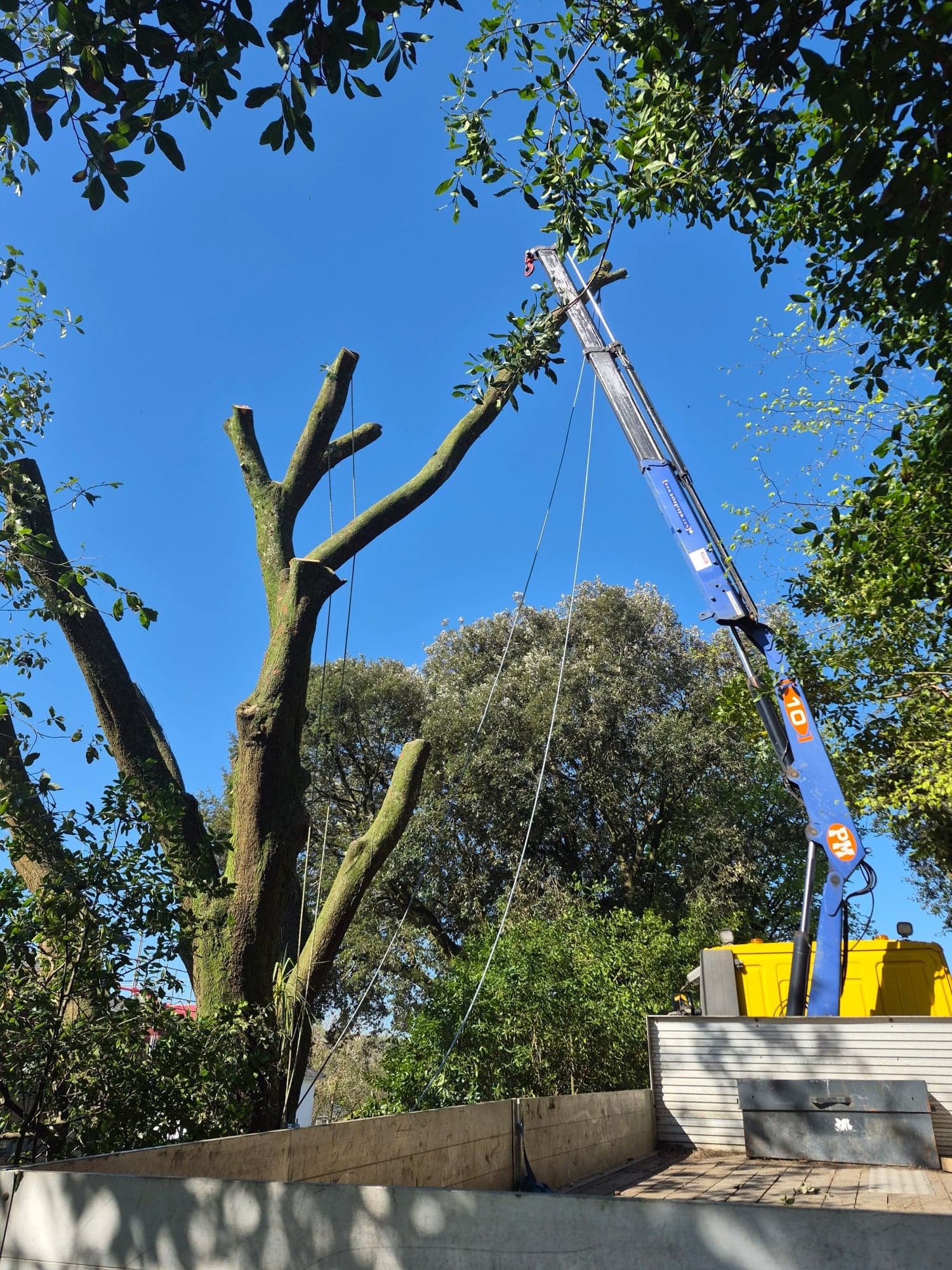
Why a crane changes the job
A conventional removal of a big tree in a garden is done with rigging: the climber cuts a section, it is lowered on ropes to a landing zone, the ground crew drag it clear, and the whole thing repeats a great many times. It works, and we still do it where a crane cannot reach, but it is slow and every section has to travel through whatever is below the tree.
With a crane the climber attaches each section to the hook before cutting, and the crane lifts it straight up and over to the lorry or the chipper. Sections can be much larger, so there are far fewer cuts, and nothing is dragged across the lawn, the borders or the drive. Where we can use one of our cranes on a removal we are normally able to reduce time on site by 75 percent, which is where most of the saving comes from.
The kit, honestly described
Our cranes are small and manoeuvrable rather than enormous. Most cannot lift more than about two tonnes, but for their size they are extremely efficient at tree work. The newest is a Bocker 32-2000, which lifts 450 kg at 22 m or 250 kg at 32 m, all from an 8 m long, 7.5 tonne vehicle that can set up on a driveway or in other restricted areas where a bigger crane could never go. For the largest trees we can bring in a larger mobile crane.
Most tree surgeons use a 3.5 tonne tipper with a payload of around 1.5 tonnes, which means leaving site to tip regularly on a big removal. We use an 18 tonne short wheelbase lorry with a loader crane and a 10 tonne payload, so we stay on site loading for much longer. A 2.6 tonne digger with a timber grab lifts sections that a person would otherwise have to cut into pieces to move, and our chipper takes 9 inch material where most take 6, so branches are processed faster.
Where it works and where it does not
The crane needs somewhere to stand within reach of the tree: a drive, a road with permission to close a lane, a yard, a field gateway, a car park. From there the boom can reach over a house, a wall or a hedge. We look at every job before quoting, measure the reach and the weights, and tell you straight whether a crane will work or whether the job is a rigging job.
Trees over roads and pavements usually need a permit from Cornwall Council for the lane closure or parking suspension, and we arrange that as part of the job.
Large and dangerous trees
Dead trees, trees with fungal decay at the base, storm damaged trees and trees leaning over buildings are the ones where a crane earns its keep most clearly. Instead of a climber working in a compromised tree, the sections can be supported by the crane before they are cut, which takes a great deal of the risk out of the removal. If you have a tree you are worried about, the free tree health check is the place to start.